Friday, October 23, 2015

NEA launches new database

I came across this news that NEA has launched a new database that allows firms to compare the packaging weight of their products against the benchmarks of similar products sold here in Singapore. It was launched just yesterday at the 3R Packaging Awards ceremony, where 16 firms, including Nestle, Coca-Cola and Subway, were presented awards in recognition for their packaging-reducing efforts.
(Obtained from NEA 3R Packaging Awards 2015 booklet)

Last year, domestic waste made up 57% of the waste disposed of in Singapore, and a third was due to packaging waste. This shows the significance of product packaging in contributing to our waste. This database enables firms to know where they currently stand in green efforts compared to other firms, and can be a gauge for them to improve. The database currently contains only packaging benchmarks of six products - beer, carbonated beverages, chilled juice, fresh milk, non-chilled beverages and water - but more products will be gradually added in future. The benchmarks are quite representative of local products as over 400 of these products in the six categories were measured. 

This database is an initiative under the Singapore Packaging Agreement (SPA). The inception of the SPA in 2007 has led to reduction in 26,000 tonnes of packaging waste and cumulative savings of $58 million. In addition to the benchmarks, the cost savings is another motivation for firms to reduce their packaging.

Many firms embark on green efforts for the sake of displaying their corporate social responsibility (CSR), but do not genuinely care about the environment. Hopefully, this new database will be a step forward in incorporating a green mindset into firms, and encourage genuine green efforts as a norm, not just for show. 

References
NEA launches database for firms to benchmark packaging against other local products (Channel NewsAsia)
http://www.channelnewsasia.com/news/singapore/nea-launches-database-for/2211286.html

News Releases (NEA Launches Packaging Benchmarking Database to Encourage Businesses to Reduce Waste)
http://www.nea.gov.sg/corporate-functions/newsroom/news-releases/nea-launches-packaging-benchmarking-database-to-encourage-businesses-to-reduce-waste

Wednesday, October 21, 2015

Photovoltaic Technology

Solar energy is a type of renewable energy that has been developed in the bid to reduce reliance on conventional ways of producing energy, such as from coal and natural gas. It is termed as clean energy as it does not pollute the environment, whereas extraction and burning of coal and natural gas release massive amounts of pollutants.

Solar panels on the roof of Choa Chu Kang Waterworks. (Taken from http://www. channelnewsasia.com/news/singapore/choa-chu-kang-water-plant/2220520.html)

Photovoltaic (PV) technology is a type of solar energy which harnesses the light energy from the Sun. Since the development of the first PV cell in 1883, with an efficiency lower than 1%, extensive research and development has been done to improve the efficiency and to reduce the cost of PV technology. However, the potential of PV technology has not been fully discovered, and it still remains more expensive than conventional energy. Although PV technology relies on the non-exhaustive solar energy, it is not totally reliable as energy can only be produced in the day, and the amount of energy depends on the strength of the sunlight. 

Despite its limitations, PV technology has been adopted in many places across the world. Here in Singapore, we can observe PV cells on some street lamps and also on rooftops of certain buildings. The International Space Station primarily uses PV technology to power its systems. Even though PV technology is not at its maximum potential, its implementation is a good stepping stone towards a future of renewable energy. For one, usage of PV technology will raise awareness for the need for renewable energy. In addition, should PV technology improve in the future (which it probably will), further implementation will be made easier due to its existing usage and support given to it. 


References
Singh, G. K. (2013). Solar power generation by PV (photovoltaic) technology: a review. Energy53, 1-13. Doi: 10.1016/j.energy.2013.02.057

Thursday, October 15, 2015

Volkswagen cheating

I recently came across the news that Volkswagen vehicles were found to be equipped with defeat devices that allowed them to skew emission data during tests. In fact, the company claimed that up to 11 million of their vehicles were equipped with such devices. Defeat devices are able to detect when the cars are undergoing tests, and switch on pollution controls to meet regulations. On the road however, the pollution controls remain switched off, which boosted the cars' performances and fuel efficiency.

A Volkswagen vehicle. (Taken from http://arstechnica.com/cars/2015/10/
volkswagens-emissions-cheating-scandal-has-a-long-complicated-history/)
It is worrying to see major firms engaging in practices are detrimental to our environmental. Usually, such practices are due to cost reasons. Perhaps the firm was unable to find a cost-effective way to properly reduce emissions and still maintain the performance of the cars. The Volkswagen cheating is just one of many examples of the ways firms try to meet regulations. In fact, firms are only interested in profits, and most of them will use the most cost-effective methods to meet regulations. When regulations are hard to meet, underhand methods may be used. The same applies for Corporate Social Responsibility, where firms go green for the sake of achieving a certain level of "responsibility".

This is a very real example of how environmental goals are almost always in conflict with economic goals, and it is probably worse in developing countries. Nevertheless, authorities and environmental activists still need to continue their efforts to bridge these two goals together.


References
91,000 vehicles in Australia affected by VW cheating (Channel NewsAsia)
http://www.channelnewsasia.com/news/asiapacific/91-000-vehicles-in/2175546.html

Volkswagen’s emissions cheating scandal has a long, complicated history
http://arstechnica.com/cars/2015/10/volkswagens-emissions-cheating-scandal-has-a-long-complicated-history/

Sunday, October 4, 2015

Payment for Ecosystem Services

Payment for Ecosystem Services (PES) is a payment which seeks to decrease pollution and preserve the environment. Incentives are given to landowners or farmers for management of their land, such as paying farmers to adopt less polluting agricultural methods and paying landowners to preserve the land. The payers can be the government, with the interests of the people, or the private sector for their own interests (e.g. companies adopting PES to meet pollution regulations).

Although PES is beneficial to the environment, there are difficulties implementing it. Quantifying the value of an ecosystem is an issue as it is hard to determine how much the ecosystem is actually worth, and different parties view the value differently. Furthermore, it is difficult to ensure guaranteed results due to varying conditions of each ecosystem. In addition, the services provided only last a certain period, thereafter pollution may return, cancelling off any positive effects that PES has brought.

PES is still a viable option for keeping pollution in control. It will be adopted even more in the future alongside greater consumption, production, and the resulting pollution by mankind. Improvements in PES will be required to meet future demands. Cost-savings and effectiveness of the services can be increased with R&D. Occasional checks and enforcement will be needed to ensure the provided services are effective. Long term plans will have to come in play after PES contracts expire to protect the ecosystems.


References

Wunder, S. (2007). The efficiency of payments for environmental services in tropical conservation. Conservation biology21(1), 48-58. Doi: 10.1111/j.1523-1739.2006.00559.x

Tuesday, September 22, 2015

SustAIRnable Future

With the recent haze in Singapore, I thought it would be good to write a post on air pollution.

In nature, "air pollution" exists - e.g. sulphur dioxide from volcano eruptions. However, today's air pollution is significantly caused by anthropogenic activities. It may be as simple as spraying pesticides, to slash and burn and factory emissions. All this contribute to a deteriorating air quality, which can affect health and living standards.

The Largest Air Purifier Ever Built Sucks Up Smog And Turns It Into Gem StonesĀ 
(Taken from http://gizmodo.com/the
-largest-air-purifier-ever-built-sucks-
up-smog-and-t-1729298355)
A couple of weeks back, I chanced upon this article titled "The largest air purifier ever built sucks up smog and turns it into gem stones". The article talks about a "Smog Free Tower" which adsorbs dust particles from the air using ion technology. The Smog Free Tower is capable of filtering 30,000 cubic meters of air per hour, operating on green energy. Interestingly, the particles are compacted and placed inside a ring - a gimmick to garner supporters and donations.


This Smog Free Project was launched on 4th September 2015 in Rotterdam, Netherlands. Currently the first of its kind, the team aims to expand the project. However, bearing high costs, this project is dependent on donations and sponsors. Below is the video of the project.


It is heartening to see efforts to reduce pollution. Although such projects do not address the roots of the problems, they certainly contribute to technological materialism. Perhaps it paves the way for us to move further down the Environmental Kuznet's Curve - towards a more sustainable future. 

References

The Largest Air Purifier Ever Built Sucks Up Smog And Turns It Into Gem Stones  (Gizmodo)
http://gizmodo.com/the-largest-air-purifier-ever-built-sucks-up-smog-and-t-1729298355

Studio Roosegaarde (— Smog Free Project)
https://www.studioroosegaarde.net/project/smog-free-project/

Sunday, September 13, 2015

Sustainable solutions to mining?

Mining generates a lot of waste. One way to prevent it from seeping out to the environment would be to store it - in dams.

Tailings are waste products of mining. They consist of residual metals and minerals, often containing water and chemicals from the extraction process. Most mining sites have tailing dams to store the tailings.

Baia Mare spill
(Taken from http://www.mediafax.ro/politic/elena-basescu-accidentul-din-ungaria-mult-mai-grav-decat-cel-produs-la-baia-mare-in-2000-7506314)

However, accidents do occur. The Baia Mare cyanide spill happened when the tailings dam gave way. Tailings which contained high amounts of toxic cyanide from gold-mining spilled out into nearby rivers.

Although it is good to have measures to control pollution, are these solutions carried out in the interest of the environment? Mining companies, like any other companies, are interested in profits. Given a choice, the majority would likely not bother with the environmental impacts. Fortunately, many countries have regulations in place that mandate some form of pollution control. But with profit driven mindsets, few companies will go great lengths to minimise environmental impact, and rather just meet the guidelines.


Recycling of metals
(Taken from http://www.conserve-energy-future.com/RecyclingMetal.php)

To reduce mining and limit the pollution, alternatives have to be considered. Recycling of metals is one option. Recycling of aluminium cans and scrap metal are examples we see daily. Besides reducing dependency on mining, recycling also saves almost 75% of energy compared to production from ores.

Another alternative is the production of synthetic diamonds. These are produced by mimicking natural conditions, i.e. high temperature and pressure. Most of the synthetic diamonds are for industrial uses, as there are economic concerns that excessive supply of synthetic diamonds will lower the value of diamonds. Furthermore, real diamonds are preferred when it comes to jewelry - just like how people rather have "real" than "counterfeit" products.

Although minimising environmental pollution is desirable, economic, political and even social obstacles stand in the way. Much is up to the leaders to pass and enforce environmentally-sustainable laws. On a smaller scale, public education - e.g. how goods are produced - will let consumers know the impact of their demand.


References

How are waste materials managed at mine sites | MiningFacts.org 
http://www.miningfacts.org/Environment/How-are-waste-materials-managed-at-mine-sites/

The Baia Mare Gold Mine Cyanide Spill: Causes, Impacts and Liability (ReliefWeb)
http://reliefweb.int/report/hungary/baia-mare-gold-mine-cyanide-spill-causes-impacts-and-liability

Will Synthetic Diamonds Take Over? (The Natural Sapphire Company Blog)
http://www.thenaturalsapphirecompany.com/blog/will-synthetic-diamonds-take

Recycling Metal - Conserve Energy Future (ConserveEnergyFuture)
http://www.conserve-energy-future.com/RecyclingMetal.php


Sunday, September 6, 2015

Mining

Mining is a means to obtain resources such as coal, metals and minerals. These resources are required for energy production, construction and aesthetic purposes etc. In this post, I will focus on the environmental impacts of surface mining.


(Taken from http://www.snipview.com/q/Surface%20mines?tab=images)
Surface mining is a type of mining that removes vegetation, soil and rocks from the Earth's surface to reach the resources underneath. This results in the loss of biodiversity which severely disrupts the ecosystem.

When the ground below is exposed, naturally occurring substances like arsenic and lead can become wind-borne and have adverse health effects when inhaled.

In addition, soil erosion and flooding will occur without the presence of forests to hold the soil in place and act as catchment for rainwater. Flooding and soil erosion can cause further damage to the ecosystem and people living at lower altitudes.


Iron oxyhydroxide can be seen in this acid mine drainage.
(Taken from http://phys.org/news/2012-10-indiana-coal-
reclamation-years.html)


The term 'acid mine drainage' is used to describe the surface runoff that flows through mining sites. The drainage contains acid that is formed when rainwater mixes with sulphur compounds in the soil. The acidity dissolves compounds which contain heavy metals like lead, copper and mercury. As it flows down into rivers, the people and organisms will get affected.
(Taken from http://www.salem-news.com/articles/march112010/
myths-water-rb.php)


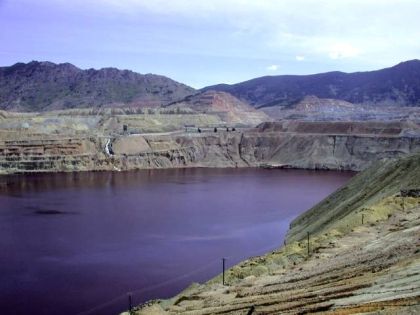
Mining sites collect stagnant water, which are potential mosquito breeding areas.

The picture on the right shows the Berkeley Pit. The mine has stopped operations since 1982 and is now filled with groundwater.


Mining is devastating to the environment. However, the people who benefit most from mining are mostly unaware of such devastation. Will heightened awareness help to reduce mining? In my next post, I will discuss the methods used to reduce negative impacts of mining, and alternatives to mining.


References

Book about Indiana coal mine reclamation compiles years of research (Book about Indiana coal mine reclamation compiles years of research)
http://phys.org/news/2012-10-indiana-coal-reclamation-years.html

Environmental Impact of Strip Mining (Bright Hub)
http://www.brighthub.com/environment/science-environmental/articles/19087.aspx

Methods of Mining. University of Kentucky (Methods of Mining. University of Kentucky)
https://www.uky.edu/KGS/coal/coal_mining.htm

Sierra Leone Mining and Environment (LEONE Case) (SIERRA LEONE MINING)
http://www1.american.edu/ted/LEONE.HTM

U.S. Environmental Protection Agency
http://www.sosbluewaters.org/epa-what-is-acid-mine-drainage%5B1%5D.pdf